I Introduction. Creativity & Remote Objects

Bernhard Schmidt and the Schmidt Camera
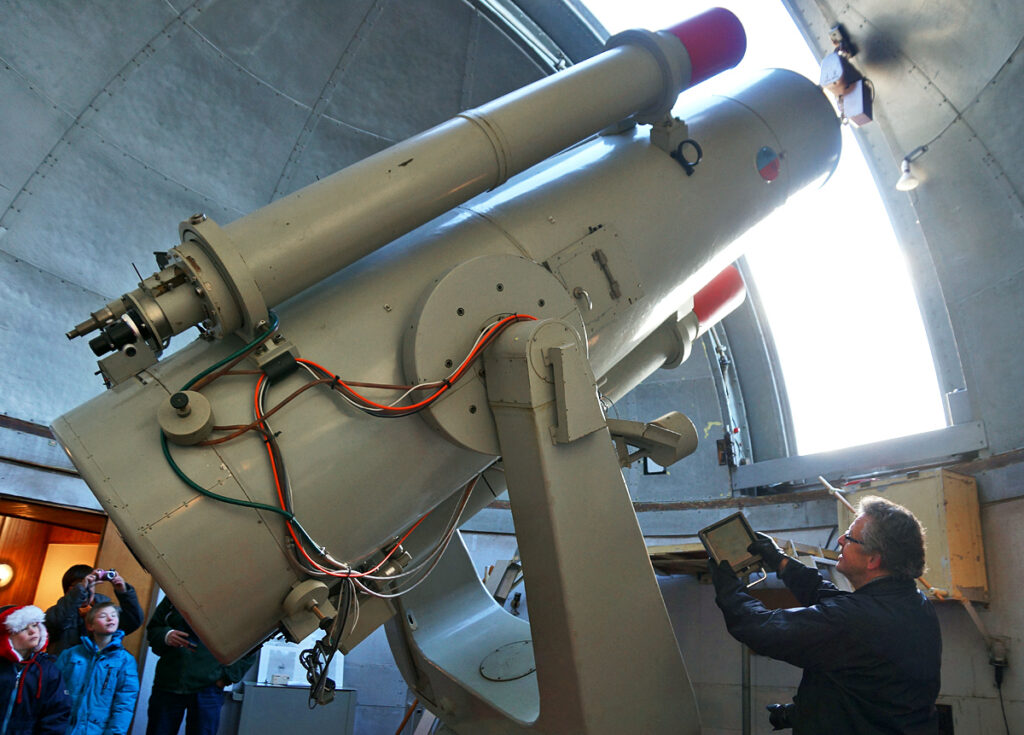
In 1930, Bernhard Schmidt from Naissaar developed an optical system, the so-called Schmidt camera. The invention made it possible to obtain flawless images of large areas of the sky. Since the invention was completed during the great global economic crisis, it did not immediately find wider application. In 1935, Berchard Schmidt died without seeing the great success of his invention.
The invention became famous 15 years after its development and 10 years after the inventor's death, when Schmidt's camera was put into use at the Mount Palomar Observatory in the United States. This step led to a revolution in optical astronomy, as the Schmidt telescope could be used to view and photograph very large areas of the universe, and enabled the creation of modern precise celestials. The Schmidt camera is one of the most famous optical systems of the 20th century.
But in Ernst Öpiku's archive, I found a question he asked himself and his fellow workers. In March 1950, in the first issue of the Irish Astronomical Journal, founded by himself, he reports that he had asked: why didn't former mathematicians come up with Schmidt's camera?
English astronomer Dr E. B. Armstrong replied: the idea was too simple!
Finnish astronomer, Yrjö Väisälä from Turku, who improved the Schmidt's telescope, seconded: “I was coming to the idea of a correction plate in 1924, but I didn't; now at least Estonia gained that honor!”
Tiit Kändler "The Brilliant Inventor Bernhard Schmidt's Path to Telescopes"
 English
  Estonian