In the mid-1990s, complex congenital heart surgeries had a very high mortality rates in Bristol, England. Marc de Leval, a professor at Great Ormond Street Children's Hospital, asked himself whether the cause was personnel-related circumstances such as exhaustion, or whether factors involving the patient played a more important role. De Leval studied all coronary artery bypass operations carried out in the UK over two years and discovered that the problem arises on the journey from the operating theatre to intensive care. It means when the patient is moved from one stage of a complex procedure to another.
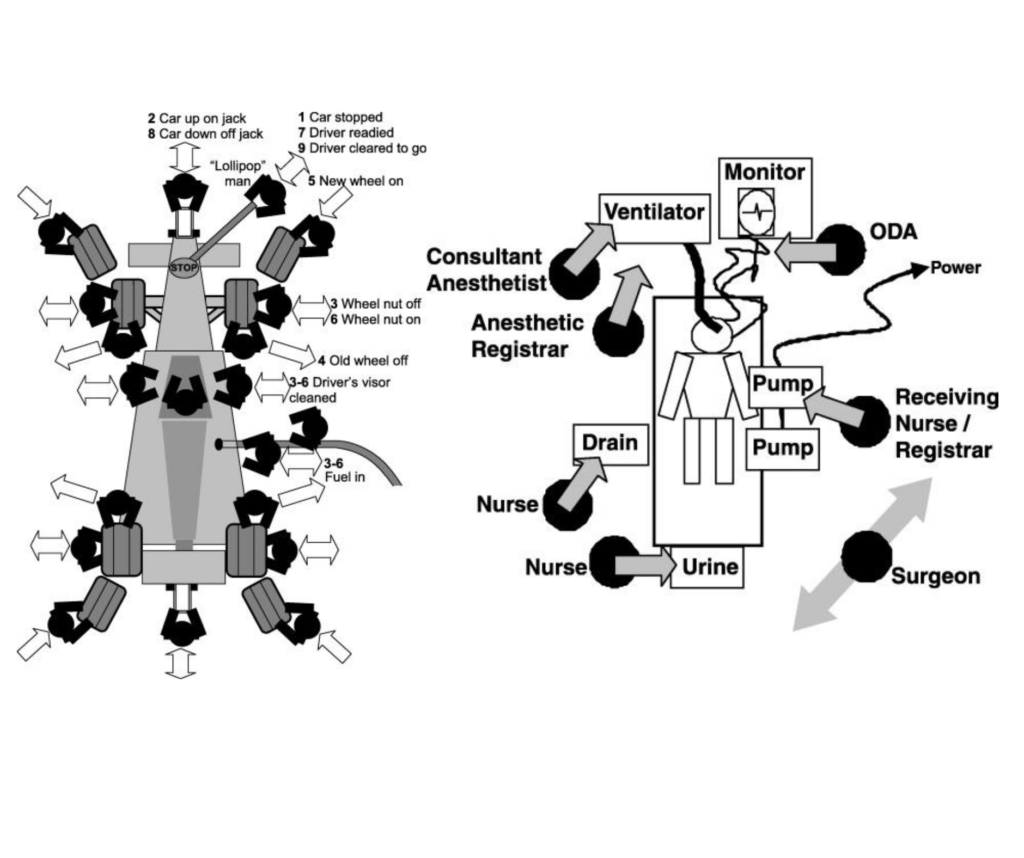
So he and Dr Martin Elliot, head of the department of heart surgery, and Dr Allan Goldman, head of intensive care for children, set out to explore how such a problem has been solved in other hospitals. But the solution was instead found from Formula 1 pit-stop model. In the 1990-s, the F1's pit-stop team faced even more demanding job: in addition to changing tires, the formulas were refueled during a pit stop, and the entire procedure took about seven seconds. Doctors saw a strong similarity here with a team of surgeons, anesthesiologist and ICU staff who had to hand over patient, equipment and information safely and quickly from the operating theatre to intensive care.
Doctors went to Italy to visit the Formula 1 team to look into the matter more closely, and they were also given permission to monitor teams work in a racing situation. As a result, they realised the importance of accurately mapping and describing the stages of the process. In addition, doctors noticed the important role of the bit-stop co-ordinator, or so-called lollipop man.
After the trip, the hospital team made a video of handover of patients from surgery to intensive care and sent it to the Formula 1 team for review. Ferrari's racing team was surprised at how clumsy the process was in the hospital, not to mention the lack of a clear manager. In addition, they were amazed by all the noise that came with it - they themselves acted quietly in the bit-stop and without using excessive words. Thanks to observations from the racing world, the hospital redesigned and improved the quality and safety of handover of patients from surgery to intensive careand. The number of medical errors fell from 30% to 10%.
Look outside the box to find creative solutions. Especially in these uncertain times, when people are faced with new challenges: they need to analyze problems they have never faced before and to reflect on opportunities they have never thought about before.

 English
  Estonian